

چمڙا
| چمڙا | |
|---|---|
| سائنسي درجا بندي | |
| ذيلي ترتيبون | |
|
(روايتي): (تازو): | |
| چمڙن جي جنسن جي عالمي سطح جي ورھاست |
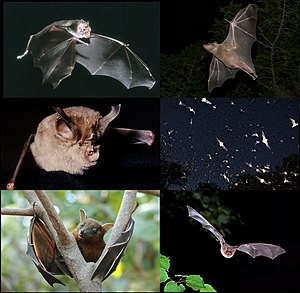
چمڙا (Bats)، جنھن کي اردو ۾ چمگادڙ، عربي ۾ خماش، فارسي ۾ شب پره ۽ ھندي ۾ موش ڪور چوندا آهن، آرڊر ڪائيراپٽيرا (Chiroptera) جا اڏامندڙ مماليا جانور آهن. انهن جا اڳيان پير پرن وانگر پتلي جھلي هوندا آهن، جنهن کي پر جي جاء تي استعمال ڪندا آهن. اها واحد مماليا جانور آهن جيڪي صحيح ۽ مسلسل پرواز ڪرڻ جي قابل آهن. چمڙا اڪثر پکين جي ڀيٽ ۾ اُڏامڻ ۾ وڌيڪ چست هوندا آهن، پنهنجي تمام ڊگھي پکڙيل پرن سان اڏامندا آهن جيڪا پتلي جھلي يا "پٽاجيئم" سان ڍڪيل هوندا آهن. سڀ کان ننڍو چمڙو ۽ غالباً سڀ کان ننڍو مماليا جانور، ”ڪيٽي جو سوئر وانگر نڪ وارو چمڙو" آهي، جنهن جي ڊيگهه 29 کان 34 ملي ميٽر (1.1–1.3 انچ)، پر جو ڦيلاء 150 ملي ميٽر (5.9 انچ) ۽ وزن 2 کان 2.6 گرام (0.071 کان 0.092 اونس) هوندو آهي ۽ سڀ کان وڏا چمڙا، ”اُڏامندڙ لومڙ“ آهن، جن ۾ وڏي سنهري تاج واري "فلائنگ لومڙ" (Acerodon jubatus) جو وزن 1.6 ڪلوگرام (3.5 پائونڊ) ۽ پرن جي پکيڙ 1.7 ميٽر (5 فوٽ 7 انچ) هوندي آهي.
روڊينٽ کان پوءِ، مماليا جانورن جو ٻيو نمبر وڏو آرڊر، چمڙا، سڄي دنيا ۾ 1,400 کان وڌيڪ نوعن سان گڏ سڄي دنيا ۾ درجه بندي ڪيل مماليا جانورن جي 20 سيڪڙو تي مشتمل آهي. اهي روايتي طور تي ٻن ماتحت نسلن: وڏي پيماني تي ميوا کائڻ وارا ميگا بيٽس ۽ ايڪولوڪيٽنگ مائڪرو بيٽس ۾ ورهايل هئا. پر وڌيڪ تازا ثبوت، آرڊر کي ينپيٽروچيروپٽيرا ۽ يانگوچيروپٽيرا، ميگا بيٽس سان گڏ اڳوڻي ميمبرن جي ڪيترن ئي قسمن سان گڏ مائڪرو بيٽس، ۾ ورهائڻ جي حمايت ڪئي آهي. ڪيترائي چمڙا جهيت خور آهن ۽ باقي گھڻا ميوا کائڻ وارا يا نيڪٽاريوورس (گلن جو رس پيئڻ وارا) آهن. ڪجھه جنسون جهيت کان سواءِ ٻين جانورن کي به کائيندا آهن. مثال طور، ويمپائر چمڙا رت پيئندا آهن. گھڻا چمڙا ڏينهن جو ٻاهر ڪونه نڪرندا آهن. سُڃين جاين ۾ يا وڻن جي اونداهن هنڌن تي اوبتو ٽنگيل ڏسڻ ۾ ايندا آهن يا ڪنهن وڻ جي پور اندر لڪل هوندا آهن. سج لهڻ بعد ڪجهه اونداهي ٿي، ته پوءِ آڏا اُبتا لامارا ڏيندا اُڏامندا رهندا آهن.[1] ۽ گھڻا ھار غارن يا ٻين پناهگيرن ۾ رھندا آھن. اهو غير يقيني آهي ته ڇا چمڙا اهو رويو شڪارين کان بچڻ لاء اختيار ڪندا آهن؟ چمگادڙ سواءِ انتهائي ٿڌي علائقن جي، سڄي دنيا ۾ موجود آهن. اهي گلن جي پولينيشن ۽ ٻج پکيڙڻ لاء سندن ماحولياتي نظام ۾ اهم آهن؛ ڪيترائي اڀرندڙ ٻوٽا، انهن خدمتن لاءِ مڪمل طور تي چمڙن تي ڀاڙين ٿا.
چمڙا انسانن کي ڪجهه سڌا فائدا، ڪجهه نقصانن جي قيمت تي مهيا ڪن ٿا. چمڙن جي گوبر کي غارن مان گوانو طور ڪڍيو ويندو آهي ۽ ڀاڻ طور استعمال ڪيو ويندو آهي. چمڙا جهيت کي استعمال ڪندي، پيسٽيسائڊ جي ضرورت کي گھٽائڻ ۽ ٻين انتظامن جي ضرورت کي گھٽائڻ ٿا. اهي ڪڏهن ڪڏهن ڪافي تعداد ۾ انساني آبادين جي ويجهو هوندا آهن ۽ سياحن لاء ڪشش جو ذريعو بڻجندا آهن. اها ايشيا ۽ پئسفڪ ريم ۾ خوراڪ طور استعمال ڪيا ويندا آهن. بهرحال، ميون کي خراب ڪرڻ جي ڪري، اڪثر ميوا پوکيندڙن طرفان انهن کي ڪيٽ سمجهيو ويندو آهي. انهن جي فزيالوجي جي ڪري، چمڙا جانورن جا اها قسم آهن جيڪا ڪيترن ئي بيمارين، جهڙوڪ ريبيز، جي قدرتي ذخيري طور ڪم ڪن ٿا ۽ جيئن ته اهي انتهائي موبائل، سماجي ۽ گهڻي وقت تائين رهن ٿا، ان ڪري اهي آسانيءَ سان پاڻ ۾ بيماري پکيڙي سگهن ٿا. جيڪڏهن انسان چمڙن سان لهه وچڙ ۾ اچن ٿا، اهي خاصيتون انسانن لاءِ ممڪن طور خطرناڪ بڻجي وڃن ٿيون. ڪجهه چمڙا مڇرن جا شڪار ڪندڙ به آهن، جيڪي مڇرن مان پيدا ٿيندڙ بيمارين جي منتقلي کي دٻائي ڇڏيندا آهن. ثقافت جي لحاظ کان، چمڙا علامتي طور تي مثبت خاصيتن، جهڙوڪ ڪجهه بيمارين يا خطرن کان بچاء، ٻيهر جنم، يا ڊگهي زندگي سان لاڳاپيل ٿي سگهن ٿا، پر اولهه ۾، چمڙا اونداهي، بدمعاشي، جادوگري، ويمپائر ۽ موت سان لاڳاپيل آهن.
نالو
[سنواريو]درجا بندي
[سنواريو]اناتومي ۽ فزيالوجي
[سنواريو]ماحوليات
[سنواريو]رويا ۽ حياتي جي تاريخ
[سنواريو]سماجي جوڙجڪ
[سنواريو]چمگادڙ اڪيلائي ۾ يا ڪالونين ۾ رهي سگهن ٿا. ميڪسيڪو فري ٽيلڊ چمگادڙ لکين ۾ رهي ٿو. جڏهن ته هارري چمگادڙ (ليسيورس سينريئس) گهڻو ڪري اڪيلو هوندو آهي (ٻارن سان گڏ مائرن کان سواءِ). وڏين ڪالونين ۾ رهڻ. اهو شڪار جي فرد لاءِ خطري کي گهٽائي ٿو. معتدل چمگادڙن جون جنسون سياري جي جڳهن تي گڏ ٿي سگهن ٿيون. جيئن سرءُ ايندو آهي. اهو انهن هنڌن تي نوجوانن جي رهنمائي ڪرڻ لاءِ ڪم ڪري سگهي ٿو. بالغن ۾ پيداوار جو اشارو ڏئي ٿو ۽ بالغن کي ٻين گروهن سان گڏ نسل پيدا ڪرڻ جي اجازت ڏئي ٿو. * ڪيترن ئي نسلن ۾ هڪ ffss (فِشن-فيوزن سماجي structure) آهي. جتي وڏي تعداد ۾ چمگادڙ هڪ بسنگ واري علائقي ۾ گڏ ٿين ٿا. ذيلي گروپن جي ٽٽڻ ۽ ميلاپ سان گڏ. انهن سماجن اندر. گروهه بندي جي رواني جي باوجود ڊگهي مدت جا تعلقات ٺهن ٿا. انهن مان ڪجهه رشتن ۾ مادري طور تي لاڳاپيل ماديون ۽ انهن جي منحصر اولاد شامل آهن. کاڌي جي حصيداري ۽ باهمي سينگار عام ويمپائر چمگادڙ (ڊيسموڊس روٽنڊس) جهڙن نسلن ۾ ٿيندي معلوم ٿئي ٿي. بونين فلائنگ فاڪس (پيٽروپس سيلافون) ۽ انڊين فلائنگ فاڪس (پيٽروپس ميڊيئس) ۾ هم جنس پرستي جو شڪار ڏٺو ويو آهي. جيتوڻيڪ هن رويي جو ڪم ۽ مقصد واضح ناهي.
Bats may roost solitarily or in colonies;[3] Mexican free-tailed bats roost in the millions, while the hoary bat (Lasiurus cinereus) is mostly solitary, aside from mothers with young.[4] Living in large colonies lessens the risk to an individual of predation.[5] Temperate bat species may swarm at hibernation sites as autumn approaches. This may serve to guide young to these sites, signal reproduction in adults and allow adults to breed with those from other groups.[6]
Several species have a fission-fusion social structure, where large numbers of bats congregate in one roosting area, along with the breaking up and mixing of subgroups. Within these societies, long-term relationships form despite the fluidity of grouping.[7] Some of these relationships consist of matrilineally related females and their dependent offspring.[8] Food sharing and mutual grooming are known to occur in species like the common vampire bat (Desmodus rotundus).[9][10] Homosexual fellatio has been observed in the Bonin flying fox (Pteropus pselaphon) and the Indian flying fox (Pteropus medius), though the function and purpose of this behaviour are not clear.[11][12]
Communication
[سنواريو]
Bats produce calls to attract mates, find roost partners and defend resources. These calls are typically low-frequency and wide-travelling.[5] Species like Daubenton's bat (Myotis daubentonii) are capable of lowering their vocal range in a manner similar to a death growl, which they use in conflict with other individuals.[13] Mexican free-tailed bats are one of the few species to "sing" like birds. Males sing to attract females, and their songs consist of chirps, trills and buzzes, the first of which has distinct "A" and "B" syllables. Bat songs are highly stereotypical but differ in syllable number, phrase order, and phrase repetitions between individuals.[14] Among greater spear-nosed bats (Phyllostomus hastatus), females produce loud, broadband calls among their roost mates to form group cohesion. Roosting groups have their own distinct calls, and these may arise from vocal learning.[15]
In a study on captive Egyptian fruit bats, 70% of the directed calls could be identified by the researchers as to which individual bat made it, and 60% could occur in four contexts: fights over food, quarrelling for a sleeping position, female aggression toward amorous males, and arguing between perched neighbours. The animals made slightly different sounds when communicating with different individual bats, especially those of the opposite sex.[16] In the highly sexually dimorphic hammer-headed bat (Hypsignathus monstrosus), males display to females with a "deep, resonating, monotonous call". Bats in flight make vocal signals for traffic control. Greater bulldog bats honk when on a collision course with each other.[17]
Bats also communicate by other means. Male little yellow-shouldered bats (Sturnira lilium) use a spicy odour secreted from their shoulder glands during the breeding season, retained and spread by specialised hairs. These hairs exist in other species, which are noticeable as collars around the necks in some Old World megabat males. Male greater sac-winged bats (Saccopteryx bilineata) have sacs in their wings in which they mix body secretions like saliva and urine to create a perfume that they sprinkle on roost sites, a behaviour known as "salting". The bats may sing while salting.[17]
Reproduction and life cycle
[سنواريو]
Most bat species are polygynous, where males mate with multiple females. Male pipistrelle, noctule, and vampire bats may claim and defend resources that attract females, such as roost sites, and mate with those females. Males unable to claim a site are forced to live on the periphery, where they have less reproductive success.[18][5] Promiscuity, where both sexes mate with multiple partners, exists in species like the Mexican free-tailed bat and the little brown bat.[19][20] There appears to be bias towards certain males among females in these bats.[5] In a few species, such as the yellow-winged bat (Lavia frons) and spectral bat, adult males and females form monogamous pairs.[5][21] Lek mating, where males aggregate and compete for female choice through display, is rare in bats[22] but occurs in the hammerheaded bat.[23]
Temperate-living bats typically mate during late summer and autumn,[24] while tropical bats may mate multiple times a year. In hibernating species, males will copulate with females in torpor.[5] Female bats use a variety of strategies to control the timing of pregnancy and the birth of young, to make delivery coincide with maximum food availability and other ecological factors. Females of some species have delayed fertilisation, in which sperm is stored in the reproductive tract for several months after mating. Mating occurs in late summer to early autumn, but fertilisation is delayed until the following late winter to early spring. Other species exhibit delayed implantation, in which the egg is fertilised after mating but does not experience all its cell divisions until external conditions become favourable.[25] In another strategy, fertilisation and implantation both occur, but development of the foetus is delayed until good conditions prevail. During the delayed development, the mother keeps the fertilised egg alive with nutrients. This process can go on for a long period because of the advanced gas exchange system.[26]

Gestation in bats ranges from around 40 days to eight months, correlating with the size of the species.[27] In most bat species, females carry and give birth to a single pup per litter. A newborn bat pup can be up to 40 percent of the mother's weight,[5] and the pelvic girdle of the female can expand during birth as the two halves are connected by a flexible ligament.[28] Females typically give birth upright or horizontally, using gravity to make the process easier. The young emerges rear-first, possibly to prevent the wings from becoming tangled, and the female holds it in her wing and tail membranes. In many species, females give birth and raise their young in maternity colonies and may assist each other in birthing.[29][30][31]
Most of the care for a young bat comes from the mother, though in monogamous species, the father plays a role. Allo-suckling, where a female suckles another mother's young, occurs in several species. This may serve to increase colony size in species where females breed in their birth colonies.[5] Young bats can fly after they develop their adult body dimensions and forelimb length. For the little brown bat, this occurs when they are eighteen days old. Weaning of young for most species takes place in under 80 days. The common vampire bat nurses its offspring beyond that, and young vampire bats achieve independence later in life than other species. This is probably due to the species's blood-based diet, as the female may not be able to feed on a nightly basis.[32]

Life expectancy
[سنواريو]The maximum lifespan of bats is three-and-a-half times that of other mammals of similar size; a Siberian bat (Myotis sibiricus) was recaptured in the wild after 41 years, making it the oldest known bat.[33] One hypothesis consistent with the rate-of-living theory links this to the fact that they slow down their metabolic rate while hibernating; bats that hibernate, on average, have a longer lifespan than bats that do not.[34][35] Another hypothesis is lower mortality is linked to flying, which would also be true for birds and gliding mammals. In addition, female bats that give birth to multiple pups annually generally have reduced lifespans compared to those that have one pup. Also, cave-roosting species may have a longer lifespan than non-roosting species due to less predation in caves.[35][33]
انسانن سان لاڳاپا
[سنواريو]طب
[سنواريو]ان جي گوشت جي تاثير گرم خشڪ آهي. ڪوئي جي منهن وارو وڏن کنڀن سان رات جو اُڏامندڙ جانور جنهن کي ڏند آهن. هن کي زنبق يا زيتون جي تيل ۾ ساڙجي، پوءِ اهو تيل فالـج ريشي، سنڌن جي سور، نقرس، عضون جي استرخاءِ وارن هنڌن تي مالش ڪرائجي. ان جي وِٺ اک جي ڦلي، ڌند ۽ اک جي روشنائيءَ لاءِ مفيد آهي، هن جو رت وارن وارين جاين تي لائجي ته وار وري نه ڄمندا. وڏن جابلو چمڙن جو کير جيڪو مادي چمڙي جي ٿڻن مان ڳڙي هيٺ ڪري گڏ ٿئي ٿو، اهو قوت مردميءَ لاءِ مفيد آهي..[36]
پڻ ڏسو
[سنواريو]حوالا
[سنواريو]- ↑ ڪتاب جو نالو ؛ تاريخ ريگستان (ڀاڱو ٻيون) -مصنف؛ رائچند هريجن -ايڊيشن؛ ٽيون- سال؛ 2005ع -ڇپائيندڙ؛ سنڌي ادبي بورڊ ڄام شورو
- ↑ "Bracken Cave Preserve", Bat Conservation International, حاصل ڪيل 4 November 2025۔
- ↑ Fenton 200195–97.
- ↑ Altringham 2011xiii.
- 1 2 3 4 5 6 7 8 حوالي جي چڪ: Invalid
<ref>tag; no text was provided for refs namedMacDonald - ↑ Fenton & Simmons 2015186–189.
- ↑ Kerth, G.; Perony, N.; Schweitzer, F. (2011). "Bats are able to maintain long-term social relationships despite the high fission–fusion dynamics of their groups". Proceedings of the Royal Society B: Biological Sciences 278 (1719): 2761–2767. doi:. PMID 21307051.
- ↑ Fornůsková, A; Petit, E. J.; Bartonička, T.; Kaňuch, P.; Butet, A.; Řehák, Z.; Bryja, J. (2014). "Strong matrilineal structure in common pipistrelle bats (Pipistrellus pipistrellus) is associated with variability in echolocation calls". Biological Journal of the Linnean Society 113 (4): 1115–1125. doi:.
- ↑ Carter, G. G.; Wilkinson, G. S. D. (2013). "Does food sharing in vampire bats demonstrate reciprocity?". Communicative & Integrative Biology 6 (6). doi:. PMID 24505498.
- ↑ Wilkinson, G. S. (1986). "Social Grooming in the Common Vampire Bat, Desmodus rotundus". Anim. Behav. 34 (6): 1880–1889. doi:. Bibcode: 1986AnBeh..34.1880W. http://www.life.umd.edu/faculty/wilkinson/Wilk_AB86.pdf.
- ↑ Sugita, Norimasa (2016). "Homosexual fellatio: erect penis licking between male Bonin Flying Foxes Pteropus pselaphon". PLOS ONE 11 (11). doi:. PMID 27824953. Bibcode: 2016PLoSO..1166024S.
- ↑ Sundar, K. S. Gopi; Kittur, Swati (2020). "An observation of homosexual fellatio in the Indian Flying Fox Pteropus medius (Temminck, 1825) (Mammalia: Chiroptera: Pteropodidae)". Journal of Threatened Taxa 12 (8): 15945–15946. doi:.
- ↑ Håkansson, J; Mikkelsen, C; Jakobsen, L; Elemans, C. P. H. (2022). "Bats expand their vocal range by recruiting different laryngeal structures for echolocation and social communication". PLOS Biology 20 (10). doi:. PMID 36445872.
- ↑ Bohn, K. M.; Schmidt-French, Barbara; Schwartz, Christine; Smotherman, Michael; Pollak, George D. (2009). "Versatility and Stereotypy of Free-Tailed Bat Songs". PLOS ONE 4 (8). doi:. PMID 19707550. Bibcode: 2009PLoSO...4.6746B.
- ↑ Boughman, J. W. (1998). "Vocal learning by greater spear-nosed bats". Proceedings of the Royal Society B: Biological Sciences 265 (1392): 227–233. doi:. PMID 9493408. Bibcode: 1998PBioS.265..227B.
- ↑ Prat, Y.; Taub, M.; Yovel, Y. (22 December 2016). "Everyday bat vocalizations contain information about emitter, addressee, context, and behavior". Scientific Reports 6. doi:. PMID 28005079. Bibcode: 2016NatSR...639419P.
- 1 2 Fenton & Simmons 2015189–194.
- ↑ Wilkinson, G. S. (1985). "The Social Organization of the Common Vampire Bat II: Mating system, genetic structure, and relatedness". Behavioral Ecology and Sociobiology 17 (2): 123–134. doi:. Bibcode: 1985BEcoS..17..123W. http://www.life.umd.edu/faculty/wilkinson/Wilk_BES85b.pdf.
- ↑ Thomas, D. W.; Fenton, M. R.; Barclay, R. M. R. (1979). "Social Behavior of the Little Brown Bat, Myotis lucifugus: I. Mating Behavior". Behavioral Ecology and Sociobiology 6 (2): 129–136. doi:. Bibcode: 1979BEcoS...6..129T.
- ↑ Keeley, A. T. H.; Keeley, B. W. (2004). "The Mating System of Tadarida brasiliensis (Chiroptera: Molossidae) in a Large Highway Bridge Colony". Journal of Mammalogy 85 (1): 113–119. doi:. Bibcode: 2004JMamm..85..113K.
- ↑ Fenton & Simmons 2015197.
- ↑ Toth, C. A.; Parsons, S. (2013). "Is lek breeding rare in bats?". Journal of Zoology 291 (1): 3–11. doi:.
- ↑ Bradbury, J. W. (1977). "Lek Mating Behavior in the Hammer-headed Bat". Zeitschrift für Tierpsychologie 45 (3): 225–255. doi:. Bibcode: 1977Ethol..45..225B. https://zenodo.org/record/8204647.
- ↑ Altringham 2011105, 115.
- ↑ Altringham 2011114.
- ↑ Neuweiler 2000247.
- ↑ Altringham 2011118.
- ↑ Fenton 2001101.
- ↑ Altringham 2011119.
- ↑ Fenton 2001102.
- ↑ Kunz, T. H.; Allgaier, A. L.; Caligiuri, S. R. (1994). "Allomaternal care: helper-assisted birth in the Rodrigues fruit bat, Pteropus rodricensis (Chiroptera: Pteropodidae)". Journal of Zoology 232 (4): 691–700. doi:.
- ↑ Fenton & Simmons 2015171.
- 1 2 Gager, Y.; Gimenez, O.; O'Mara, M. T.; Dechmann, D. K. N. (2016). "Group size, survival and surprisingly short lifespan in socially foraging bats". BMC Ecology 16 (2): 2. doi:. PMID 26767616. Bibcode: 2016BMCE...16....2G.
- ↑ Turbill, C.; Bieber, C.; Ruf, T. (2011). "Hibernation is associated with increased survival and the evolution of slow life histories among mammals". Proceedings of the Royal Society B 278 (1723): 3355–3363. doi:. PMID 21450735.
- 1 2 Wilkinson, G. S.; South, J. M. (2002). "Life history, ecology and longevity in bats". Aging Cell 1 (2): 124–131. doi:. PMID 12882342. http://www.life.umd.edu/faculty/wilkinson/Wilk_South02.pdf.
- ↑ ڪتاب: فرھنگ جعفري؛ ليکڪ: حڪيم محمد جعفر؛ ايڊيشن: 2007ع؛ پبلشر: سنڌي ادبي بورڊ، ڄامشورو.
ٻاهريان ڳنڍڻا
[سنواريو]| وڪيميڊيا العام ۾ چمڙا سان لاڳاپيل ابلاغي مواد ڏسو. |
| The Wikibook Dichotomous Key has a page on the topic of |

- of UK Bat Conservation Trust
- Tree of Life آرڪائيو ڪيا ويا 26 July 2020 حوالو موجود آهي وي بيڪ مشين.
- Microbat Vision آرڪائيو ڪيا ويا 29 January 2020 حوالو موجود آهي وي بيڪ مشين.
- Analyses of several kinds of bat echolocation
- مضمون with short description
- Short description is different from Wikidata
- Articles with 'species' microformats
- LCCN سان سڃاڻپ ڪندڙ وڪيپيڊيا مضمون
- GND سان سڃاڻپ ڪندڙ وڪيپيڊيا مضمون
- BNF سان سڃاڻپ ڪندڙ وڪيپيڊيا مضمون
- چمڙا
- حيوان
- مماليا
- ڪرنگھيدار جانور
- اڏامندڙ مماليا
- جانور جيڪا گونج استعمال ڪن ٿا
- وڊيو ڪلپس تي مشتمل مضمون
- غارن ۾ رهندڙ مماليا
- ايڪسٽيننٽ يپريسين دور م پهريون ظهور
- رات جا راجا
- جوهان فريڊرڪ بلومينباخ پاران رکيل ٽيڪسا جا نالا
- حوالن ۾ چُڪَ وارا صفحا